
Key takeaways
- Whiteboard staining (“ghosting”) is usually caused by ink left on too long, low-quality marker ink, or a surface that has been scratched over time.
- Physical damage often comes from abrasive cleaning tools, hardened erasers, or sharp objects touching the surface.
- Humidity, direct sunlight and outdoor placement can shorten a board’s lifespan, whatever the surface.
- Erasing within a day or two, using proper dry erase markers, and cleaning with the right products (never thinner) are the biggest factors you can control.
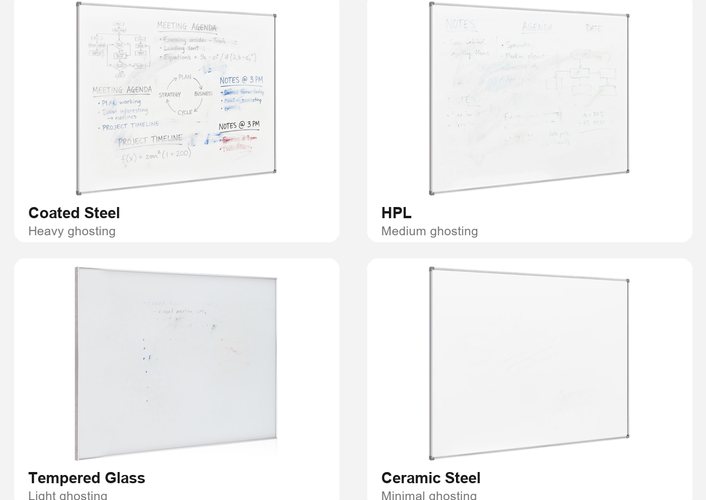
- Even with perfect care, entry-level surfaces ghost faster than premium ones like Ceramic Steel, because the surface material itself plays a big role.
If your whiteboard looks dull, stained or covered in faint shadows no matter how much you erase it, you’re not alone, and it’s usually not a sign you’ve done anything wrong. “Why is my whiteboard dirty?” is one of the most common questions we hear, and in almost every case what’s actually happening is ghosting, not dirt in the usual sense. Most whiteboard damage comes down to a handful of predictable causes, some related to the surface itself, some to everyday habits. Here’s what’s actually happening, and what you can do about it.
Why does my whiteboard have shadows or marks even after I erase it?
Those faint marks are called ghosting, and they’re the single most common complaint whiteboard owners have. It’s what almost everyone actually means when they say a whiteboard looks “dirty”, even though no real dirt or dust is involved. Marker ink is designed to sit on top of the writing surface so it wipes away easily, but if it’s left there too long, some of the pigment settles into microscopic imperfections in the surface instead of staying on top. The longer ink sits before being erased, the more likely it is to leave a shadow. This is why boards in meeting rooms used daily, with notes left up for days at a time, tend to ghost faster than boards wiped clean after every use.
Why do some markers stain a whiteboard more than others?
The ink itself is often the real problem, not the board. Marker ink is a chemical product, not just coloured liquid, and over time that chemical composition can interact with the board’s surface in ways that leave a lasting mark. Lower-quality inks are usually the biggest culprit: cheaper markers often use ink formulated for absorption rather than clean removal, so it behaves more like a permanent marker than a proper dry erase one, even if it’s labelled dry erase. If one specific marker seems to stain more than others on the same board, this is usually why.

You can test it yourself: write with two different marker brands side by side, leave them for a day, then erase both. If one leaves a visibly stronger shadow, the ink is the problem, not the board. Offices that go through markers quickly, often reaching for whatever’s cheapest, run into this more than they realise. The cost difference between a decent marker and a poor one is small, but the damage adds up over months of daily use.
Why is my whiteboard scratched, and does it actually matter?
Scratches matter because they make the surface rougher, and a rougher surface holds onto ink more stubbornly than a smooth one, making future ghosting worse. Beyond staining, whiteboards can also pick up physical damage over time. This usually comes from:
- Abrasive cleaning tools. Rough cloths, paper towels or scouring pads can create tiny scratches, which then trap ink more easily and make future ghosting worse.
- Hard or sharp objects. Rings, clipped pens, or anything with a hard edge touching the surface while writing can leave marks over time.
- Erasers that have hardened or picked up debris. An old, dirty eraser can drag grit across the surface every time it’s used, slowly scratching the board with every pass.
This is part of why premium surfaces like Ceramic Steel resist ghosting so much better over time: the smoother the surface, the less opportunity ink has to settle in.
Can humidity or sunlight damage a whiteboard?
Yes. Whiteboards are more sensitive to their surroundings than most people expect.
- Humidity. In a climate like Malaysia’s, prolonged exposure to humidity can affect certain board materials over time, particularly if a board is placed somewhere with poor ventilation or near a window that gets condensation.
- Direct sunlight. UV exposure can cause discolouration on some surfaces over long periods, even indoors if a board sits directly in a sunlit spot for years.
- Outdoor placement. Whiteboards are generally built for indoor use. If a board must be placed outdoors or in a semi-outdoor area, it should at minimum be kept covered from rain and direct sun, since ongoing exposure will shorten its lifespan whatever the surface.
Why does my office whiteboard wear out faster than others?
It’s almost never because the board itself is lower quality; it’s a matter of volume. More people writing, more marker brands in circulation, more days where notes are left up over a weekend, and less consistency in how the board gets cleaned all add up. A board wiped down properly after every use by one person will almost always outlast an identical board used by a rotating group with no set cleaning routine.
If this sounds like your office, the fix isn’t necessarily a better board. Sometimes it’s as simple as keeping a proper whiteboard cleaner and a dedicated eraser next to the board, and making a habit of erasing before the end of the day rather than leaving notes up indefinitely.

How do I stop my whiteboard from staining or ghosting?
None of this is really about being extra careful. It’s about a few simple habits that make a big difference over the life of a board:
- Erase within a day or two, not a week. The less time ink sits, the less chance it has to leave a shadow.
- Use proper dry erase markers, not off-brand or low-quality ones. If a marker consistently stains, it’s worth switching brands rather than blaming the board.
- Clean with a proper whiteboard cleaner or isopropyl alcohol, not thinner or harsh solvents. Solvents like thinner or acetone can strip the surface coating entirely, causing permanent damage rather than preventing it. A soft cloth with plain water works fine for daily wipes. Save cleaner or alcohol for stubborn marks, as using it too often can wear down the surface over time.
- Replace your eraser when it feels hard or looks dirty. A clean, soft eraser protects the surface; an old one damages it. A peel-off eraser lets you peel away the used layer for a fresh one.
- Position the board away from direct sunlight and humid spots where possible.

Will a better whiteboard surface fix staining, even with perfect care?
Sometimes, yes. To be honest, even with perfect habits, not all whiteboard surfaces perform equally. Entry-level Coated Steel boards will ghost faster than a premium surface no matter how well you care for them, simply because of what they’re made of. HPL sits in the middle: it resists ghosting better than Coated Steel, but scratches more easily than Ceramic Steel. A fused ceramic surface like Ceramic Steel resists ghosting, staining and scratching for years longer than either, because the manufacturing process creates a harder, smoother surface that ink can’t settle into as easily.

If you’ve been diligent about cleaning and your board still stains faster than you’d like, it may genuinely be a surface issue rather than a habits one, and it might be worth looking at a higher-grade surface for your next board, especially if it’s used daily.
Have questions about which whiteboard surface is right for your space? Read our full surface comparison guide, or get in touch with our team for a recommendation based on how you’ll actually be using your board.