On delivery day, every whiteboard looks the same: clean, white and ready. The difference shows up a year later. What decides it is the surface: how well it wipes, how long it lasts, whether magnets hold, and how much it costs.
The short answer
For boards used every day for years, Ceramic Steel is the best whiteboard surface: it barely ghosts, resists scratches, holds magnets strongly and carries a 25-year surface warranty. Hygienic Ceramic Steel adds protection against bacteria and viruses for healthcare and childcare. Tempered Glass suits modern meeting rooms, HPL suits everyday use on a budget, and Coated Steel is the lowest-cost choice for light use.
At our manufacturing plant in Selangor, Malaysia, we make whiteboards in six surfaces. Here is how they compare, what each one is good at, and how to choose.
The six surfaces at a glance
More stars are better. Cost runs from $ (lowest) to $$$$ (highest).
| Coated Steel | Non-Magnetic HPL | Magnetic HPL | Tempered Glass | Ceramic Steel | Hygienic Ceramic Steel | |
|---|---|---|---|---|---|---|
| Magnetic | ★★★ | N/A | ★★ | ★ | ★★★★ | ★★★★ |
| Erasability | ★ | ★ | ★ | ★★★ | ★★★ | ★★★ |
| Easy on the eyes | ★ | ★ | ★ | ★ | ★★★★ | ★★★ |
| Projectable | ★ | ★ | ★ | ★ | ★★★★ | ★★★ |
| Sustainable | ★★ | ★ | ★ | ★★★★ | ★★★★ | ★★★★ |
| Ghosting resistance* | ★ | ★★ | ★★ | ★★★ | ★★★★ | ★★★★ |
| Durable | ★ | ★★ | ★★ | ★★★★ | ★★★★★ | ★★★★★ |
| Scratch, fire, chemical and bacteria resistant | ✗ | ✗ | ✗ | ✗ | ✓ | ✓ |
| Virus resistant | ✗ | ✗ | ✗ | ✗ | ✗ | ✓ |
| Cost | $ | $ | $$ | $$$ | $$$ | $$$$ |
Ceramic Steel comes in a low-gloss or high-gloss finish, chosen when you enquire: a pale star is reached by one of the two finishes. * Terms and conditions apply.
What a year of writing does to a board
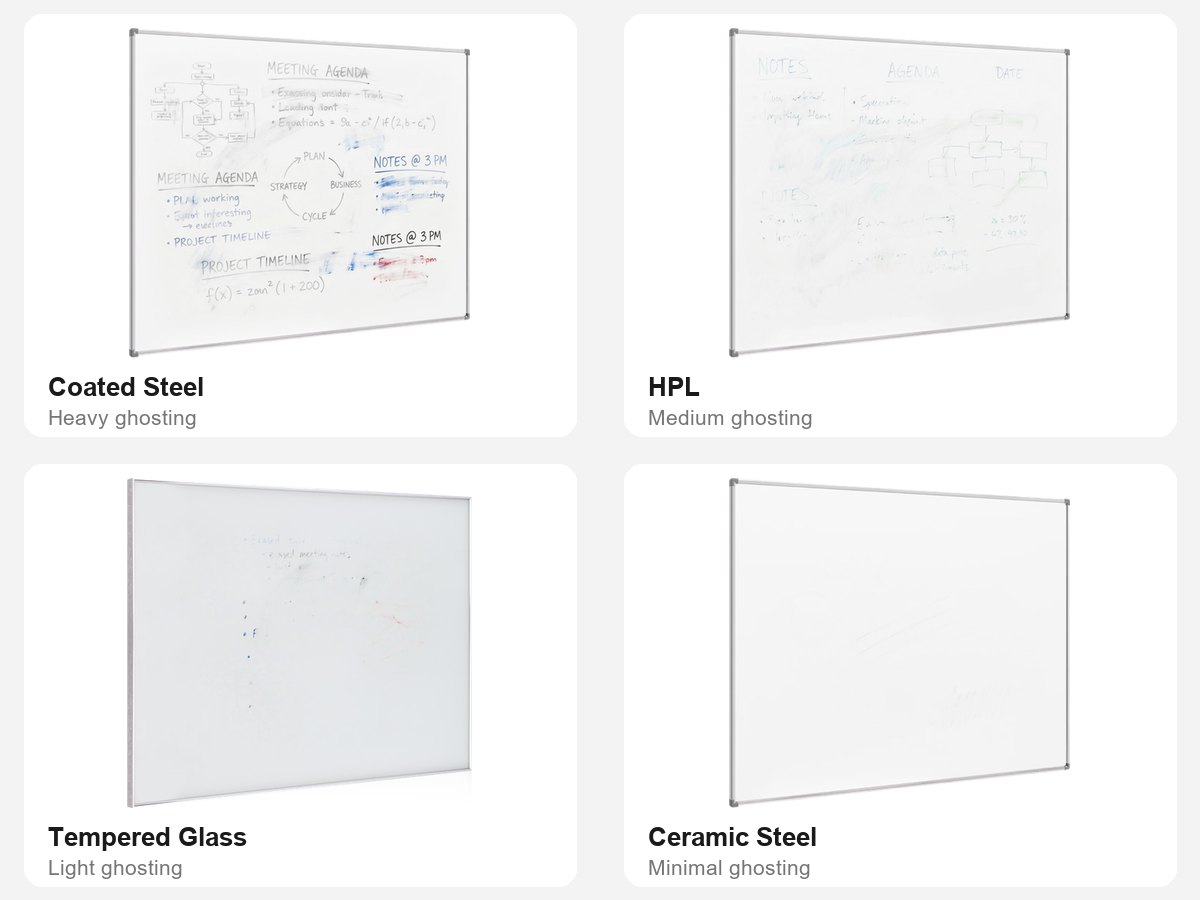
The photos at the top show four boards after one year of everyday use. The faint marks left behind are ghosting: traces of old writing that no longer wipe off. On Coated Steel it is heavy. HPL shows a medium haze, tempered glass a light one, and Ceramic Steel barely any. Ghosting is the easiest way to tell a surface that was cheap to buy from one that is cheap to own.
The surfaces, one by one
Every whiteboard is a sandwich: a writing surface on top, often a metal sheet for magnets, and a core that keeps it flat (many of ours use a honeycomb core made from recycled paper). What changes from one surface to the next is the top layer. That layer decides how ink behaves, how magnets hold and how the board ages.
Coated Steel
Entry-level magnetic, light use.
- Made of
- Painted coating on steel
- Magnets
- Good hold
- After a year
- Heavy ghosting
- Cost
- $
What it is. Also known as painted steel: a steel sheet finished with a white base coat and a clear writing coat. It is the classic whiteboard most people picture.
How it performs. Because the steel sits right under a thin coat of paint, magnets grip it well. That paint is also the weak point. A painted coating is softer than glass or enamel, and over time it picks up fine scratches and soaks up a little of every marker that touches it. Each scratch and every trace of absorbed ink holds onto the next round of writing, which is why Coated Steel ghosts the most and gets harder to wipe clean with age.
Watch out for. Abrasive pads and harsh solvents wear the coating faster.
Best for: homes, personal desks and boards that are written on now and then. Available on the Standard Whiteboard and Eco Whiteboard.
Non-Magnetic HPL
Basic non-magnetic, everyday use.
- Made of
- High-pressure laminate
- Magnets
- No
- After a year
- Medium ghosting
- Cost
- $
What it is. HPL stands for high-pressure laminate. Layers of resin-soaked paper are pressed together under heat and very high pressure into one hard, thin sheet, finished with a tough melamine-resin top layer. The sheet is then bonded onto the board.
How it performs. Pressed resin is harder and more stable than paint, so HPL holds up better than Coated Steel: fewer scratches, and ghosting that builds up more slowly. It is still a resin surface, though, and it wears and stains sooner than glass or enamel under heavy use. With no steel layer, magnets will not stick.
Watch out for. Like Coated Steel, it does not like abrasive pads or harsh solvents.
Best for: rooms on a tight budget where nothing needs to be pinned up with magnets. Available on the Standard Whiteboard.
Magnetic HPL
Budget magnetic laminate, moderate use.
- Made of
- HPL on a zinc sheet
- Magnets
- Moderate hold
- After a year
- Medium ghosting
- Cost
- $$
What it is. The same laminate writing surface, bonded onto a zinc sheet (zinc-coated steel) so the board accepts magnets.
How it performs. It writes, wipes and ages like Non-Magnetic HPL. Magnets hold, though less firmly than on Coated Steel, because the laminate sits between the magnet and the sheet.
Watch out for. The same care as any resin surface: no abrasives or harsh solvents.
Best for: everyday offices and classrooms where notices go up with magnets and the budget is sensible. Used on the Mono Whiteboard, Classic Whiteboard and most of our mobile boards.
Tempered Glass
Premium, modern and very easy to wipe.
- Made of
- 4 mm tempered glass
- Magnets
- Strong magnets needed
- After a year
- Light ghosting
- Cost
- $$$
What it is. Our Glass Board uses 4 mm tempered glass, which is heated and then cooled quickly to make it much stronger than ordinary glass. Behind it, a frosted backing helps the writing stand out, and a steel layer makes the board magnetic.
How it performs. Glass is non-porous: ink sits on top and cannot soak in. That is why it wipes very cleanly and ghosts only lightly. It is long-lasting and one of the more sustainable choices. The trade-off is reflection. A glossy glass face catches light, which makes it harder on the eyes in bright rooms and unsuitable for projection. Magnets also have to hold through the thickness of the glass, so standard magnets feel weak; use the magnetic buttons supplied, or stronger magnets.
Watch out for. Tempered glass is tough on its face, but a sharp knock to an edge or corner can chip or shatter it. It is also heavier than other boards, so mount it on a solid wall.
Best for: modern offices, meeting rooms and reception areas, where the board is part of the interior.
Ceramic Steel
Scratch-resistant magnetic, heavy use.
- Made of
- Enamel fused to steel
- Magnets
- Super strong hold
- After a year
- Minimal ghosting
- Cost
- $$$
What it is. Often called porcelain or enamel-on-steel. Our Ceramic Steel is PolyVision e³ CeramicSteel: a vitreous (glass-derived) enamel fired onto steel in a kiln at very high temperature, so the two fuse into one hard, glass-like skin on a steel base.
How it performs. Fired enamel is far harder than paint or resin, and it is non-porous, so there is nothing for ink, stains, chemicals or bacteria to sink into. That is where its resistance to scratches, stains, chemicals and bacteria comes from. Enamel is inorganic, so it does not burn or give off toxic fumes in a fire. Because the steel is directly beneath a thin enamel layer, standard magnets hold strongly. It is the most durable surface we make, and it is designed to keep its writing and erasing quality for as long as it is in use.
When you enquire, you can choose between two finishes. Both are Ceramic Steel; the difference is all about light:
- Low gloss has a softer, matte face that scatters light instead of reflecting it. There is less glare, so it is the easiest surface on the eyes and the best one to project onto.
- High gloss has an ultra-smooth face that markers glide over. It erases most cleanly and resists ghosting best, with a little more shine.
Warranty. Ceramic Steel carries a 25-year warranty on the surface.
Sustainability. A surface that rarely needs replacing creates less waste. e³ CeramicSteel is Cradle to Cradle Certified™ Bronze, 99.9% recyclable and releases no VOCs.
Watch out for. Very little. Steel can dent under a hard blow, and the boards are heavier than laminate ones. Even ink from a permanent marker can be removed with a solvent-based cleaner, though it is still best to stick to dry-erase markers.
Best for: schools, training rooms and busy offices where the board is used every day for years. Learn more in The bacteria-resistant surfaces: Ceramic Steel whiteboard, or find it on the Standard Whiteboard and Mono Whiteboard.
Hygienic Ceramic Steel
Antimicrobial magnetic, heavy use.
- Made of
- Ceramic Steel + silver
- Magnets
- Super strong hold
- After a year
- Minimal ghosting
- Cost
- $$$$
What it is. Ceramic Steel with an added ingredient: silver micro-particles built into the surface. Silver has been used to keep surfaces clean since ancient times.
How it performs. It has everything Ceramic Steel offers, plus active protection. The silver particles slowly release silver ions, which keep working on the surface for the life of the board. The surface is tested to ISO 22196 (bacteria) and ISO 21702 (viruses), and it eliminates bacteria and viruses on the surface within 24 hours. It is the only one of the six that is virus resistant. The silver is odourless, colourless and stays in the surface. Standard and strong disinfecting solutions will not damage the surface or the silver, which matters in places that clean all day.
Warranty. Like Ceramic Steel, it carries a 25-year warranty on the surface.
Watch out for. Cost. It is the premium surface, worth it where hygiene is part of the job.
Best for: hospitals, clinics, laboratories, childcare centres and busy public spaces. Available on the Mono Whiteboard, Mono Mobile and Vovo Mobile. Read more in Hygiene first: surfaces that limit what spreads.
Quick picks
- Lowest price, light use: Coated Steel.
- Everyday use on a budget: Magnetic HPL, or Non-Magnetic HPL if you never use magnets.
- A board that looks good in a modern room: Tempered Glass, or Ceramic Steel, which also looks very premium, in the NOVA by WriteBest range.
- Heavy daily use, the least ghosting, or projecting onto the board: Ceramic Steel.
- Healthcare and childcare: Hygienic Ceramic Steel.
Not sure which surface suits your room? Tell us how the board will be used, and we’ll recommend the right one. Get in touch.
Frequently asked questions
What is the best whiteboard surface?
For heavy, everyday use, Ceramic Steel (also called porcelain or enamel-on-steel) is the best whiteboard surface: it is the most durable, shows minimal ghosting after a year, holds magnets strongly and carries a 25-year surface warranty. For light use or a tight budget, Coated Steel or HPL are cheaper choices.
What is the difference between Ceramic Steel and painted steel whiteboards?
Painted steel (Coated Steel) has a soft paint coating that scratches and absorbs a little ink over time, so it ghosts heavily within a year. Ceramic Steel has a vitreous enamel fired onto steel in a kiln, which is far harder and non-porous, so it resists scratches, stains and ghosting, and carries a 25-year surface warranty.
What is whiteboard ghosting and how do I prevent it?
Ghosting is the faint trace of old writing that no longer wipes off. It happens when ink settles into scratches or a porous coating. Non-porous surfaces such as Ceramic Steel and tempered glass ghost the least. To slow it down on any board, use dry-erase markers, avoid abrasive pads and harsh solvents on painted and laminate surfaces, and clean regularly with a whiteboard cleaner.
Are glass whiteboards magnetic?
Our Glass Board is magnetic: a steel layer behind the 4 mm tempered glass holds magnets. Because the magnet has to hold through the glass, standard magnets feel weak, so use the magnetic buttons supplied or stronger magnets.
Is an HPL whiteboard magnetic?
Non-Magnetic HPL is not. Magnetic HPL is: the laminate is bonded onto a zinc sheet (zinc-coated steel), so magnets hold, though less firmly than on Coated Steel.
Can you project onto a whiteboard?
Yes, but the surface matters. Glossy surfaces such as glass reflect light and are unsuitable for projection. Low-gloss Ceramic Steel scatters light instead of reflecting it, so it is the best whiteboard surface to project onto.
Which whiteboard is best for schools and classrooms?
Classrooms use the board all day, every day, so Ceramic Steel is the best fit: it is the most durable surface, ghosts the least and holds magnets strongly. Magnetic HPL is a lower-cost option for moderate use.
Which whiteboard is best for hospitals and clinics?
Hygienic Ceramic Steel. Silver micro-particles in the surface eliminate bacteria and viruses on the surface within 24 hours (tested to ISO 22196 and ISO 21702), and standard and strong disinfectants will not damage it.
How long does a Ceramic Steel whiteboard last?
Ceramic Steel is designed to keep its writing and erasing quality for as long as it is in use, and WriteBest gives it a 25-year surface warranty. Hygienic Ceramic Steel carries the same 25-year surface warranty.
Where can I buy whiteboards in Malaysia?
WriteBest makes whiteboards in all six surfaces at its manufacturing plant in Hulu Langat, Selangor, with branches in Johor Bahru, Kota Kinabalu and Sibu. Tell us how the board will be used and we will recommend the right surface.